


Winrock acts as a third party for clients, working directly with their suppliers to go through the entire process of verifying carbon reduction activities. Clients often include companies like Nestle, and suppliers often include companies like Cargill.


Outdated processes ≠ Professional
Winrock currently validates suppliers' emission reduction activities for their clients by relying on basic Excel spreadsheets, personal note taking, and a general Asana board. This solution needs to be upgraded due to potential improvement in professionalism, security vulnerabilities, poor user experience, and Excel’s manipulation capabilities.




How might we…
translate manual workflows into a centralized system encouraging professionalism, security, and maintains familiar functionality?
Solution
A professional web platform to simplify, organize, and review client and supplier form submissions as well as track project phases, with an improved UI and automated notifications for missing information and updates
UNDERSTAND

Lack of Efficiency in Communication
After form submission, Winrock often needs to follow up via email for missing or corrected information, leading to a time-consuming and error-prone back-and-forth process with suppliers
Lack of Reliability and Professionalism
The Excel-based setup may appear unprofessional or difficult to use, with fragile formulas and manual processes that lead to errors and limit scalability.
User Experience
The experience of filling out long Excel sheets is long and arduous resulting in an unpleasant user experience
DESIGN
With a solid understanding of Winrock's work flow, we were able to start put out initial ideas for interfaces. Our team of designers took inspiration from existing applications' features like Asana, Google suite, Qualtrics, Slack, and others. This way, we ensured we weren't reinventing the wheel but instead tailoring working designs to this project's needs.

Dashboard: Big filters, sort, filter by, and search features to sift through all projects

Project View (Idea #1): Upon clicking a project from the dashboard, a user can view project information and each stage in Winrock's process

Project View (Idea #2): Be able to converse with suppliers/clients directly within the web application

Project View (Idea #2 continued): Click through project stages via tabs while viewing all documents at any time
Based on specific information provided by Winrock including all necessary project properties, sort options, and filter options, we organized the dashboard so that employees could view projects accordingly
Defining Main Filters
Instead of status (Active, In progress, etc.), Winrock preferred it so that the main tab filters relate to "Activity Type" because specific Winrock employees work on each type

Before

After

KPI Visualizations
Originally, Winrock was interested in a KPI page that would display big picture metrics. However, upon further exploration, the team realized that there wasn't enough for a whole page and that the application was quickly resembling Winrock's internal Asana board.
As a fix, we added visualizations of the main KPIs as a collapsible dropdown on the dashboard page.
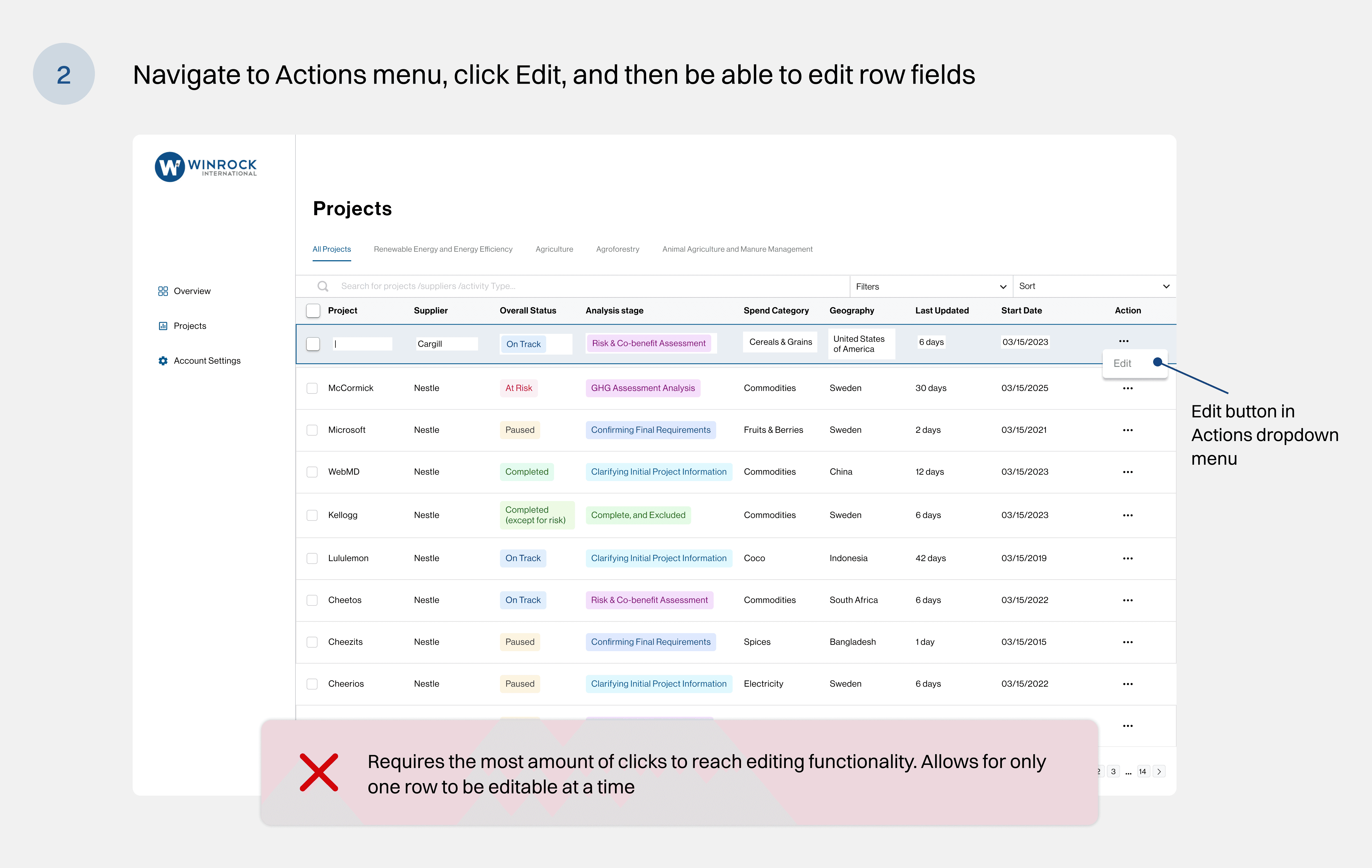
In order to edit the properties of a project, we needed to decide the best method to do so. We proposed 3 solutions to Winrock by discussing standard actions they would take when navigating the dashboard.


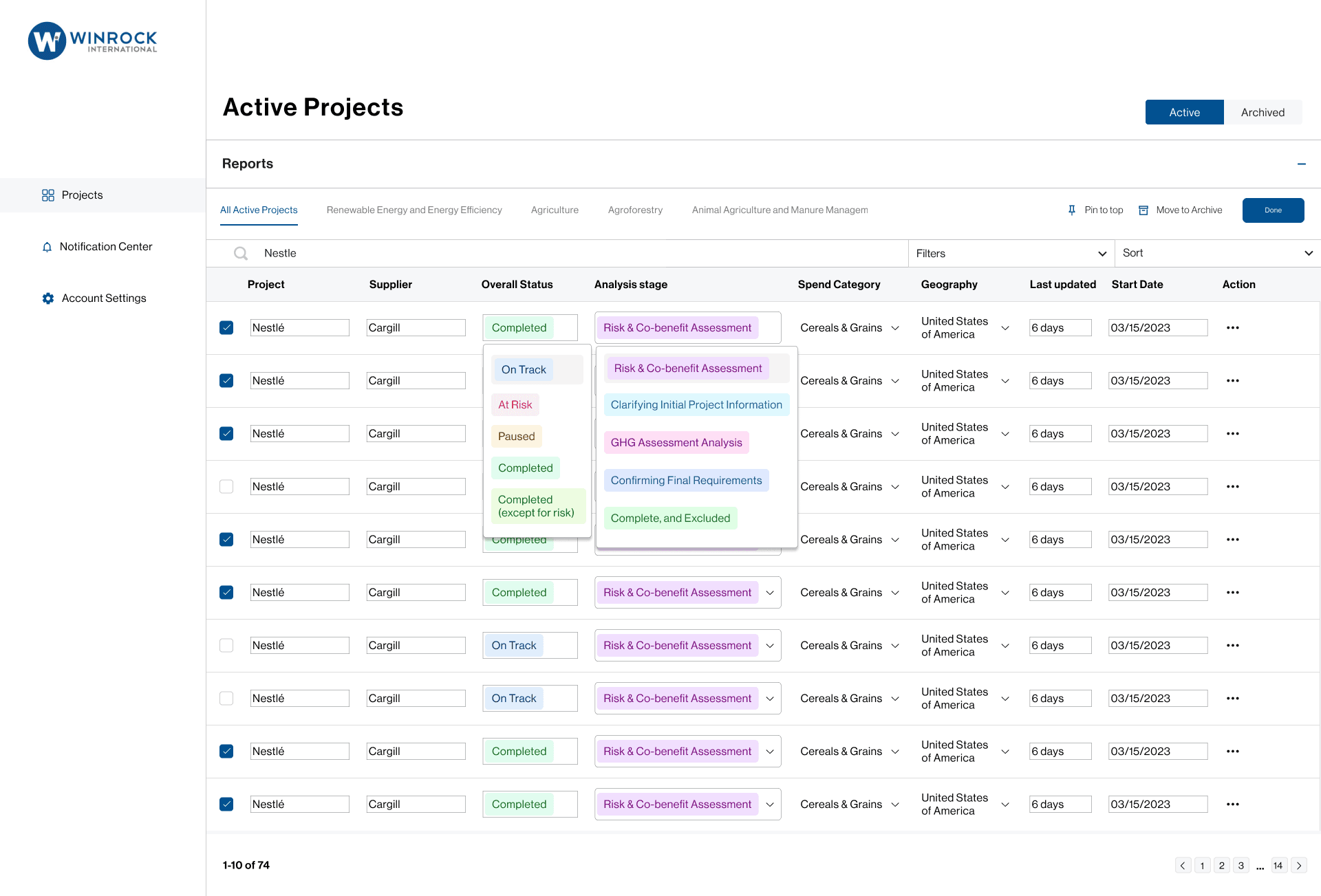
To create interactive prototypes to demo and simulate feature functionality, we maintained a design system consisting of repeating components. Any changes made would propagate to all designs.


FINAL PROTOTYPE



TAKEAWAYS
By checking in weekly with Winrock, we were able to design and define every feature each week while getting iterative feedback to keep improving our designs and ensure that every change directly reflected what Winrock needed.
Working with a mostly technical team, it was important for the designers to clearly explaining designs and hand off organized Figma designs. Dropping comments, having slack conversation, and touching base at weekly meetings was integral to team success.
Building a design from scratch encouraged me as a designer to be confident in the design decisions we made and back it up with design principles.
Within the design team, I took the initiative to coordinate agendas for design sessions, help lead conversations in client calls, be the point of contact when collaborating with engineers, and delegate weekly tasks.
